
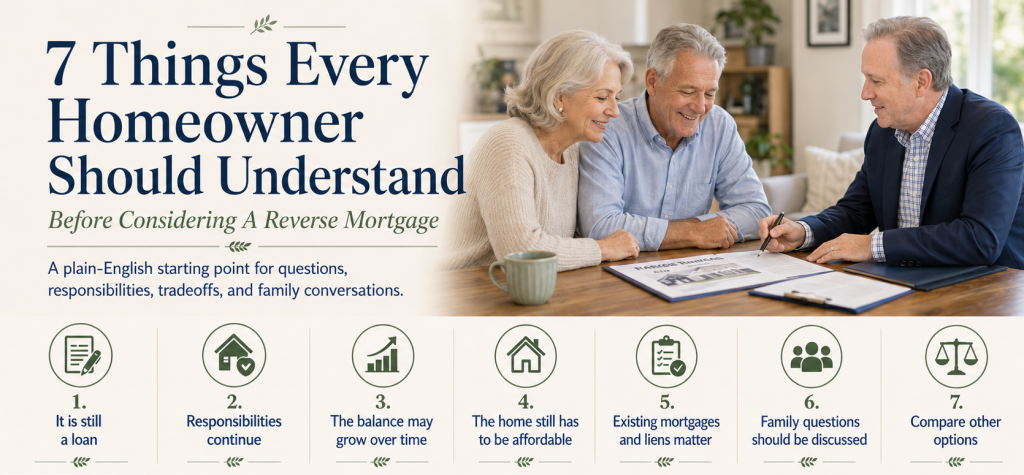
7 Things Every Homeowner Should Understand Before Considering A Reverse Mortgage
A plain-English starting point for questions, responsibilities, tradeoffs, and family conversations.
A reverse mortgage can sound simple when people talk about it quickly.
Use home equity.
Stay in the home.
Change the monthly mortgage-payment structure.
But the real conversation deserves more care than that.
A reverse mortgage is a loan secured by the home. It may be worth exploring in some situations, and it may be a poor fit in others.
The goal is not to make a fast decision.
The goal is to understand the basics clearly enough to ask better questions.
Here are seven things every homeowner should understand before considering a reverse mortgage.
1. A Reverse Mortgage Is Still a Loan
This is the first point.
A reverse mortgage is not free money.
It is not a gift.
It is not a government check.
It is a loan secured by the home.
That means the home is used as collateral, and the loan eventually has to be repaid.
The homeowner generally retains title to the property, subject to the mortgage lien and loan terms.
A better way to think about it is:
The reverse mortgage changes how the loan is structured. It does not remove the debt.
That one sentence clears up many misunderstandings.
2. Scheduled Monthly Principal-And-Interest Payments Generally Are Not Required, But Responsibilities Continue
One of the most common things people hear is that a reverse mortgage has “no monthly payments.”
That statement is incomplete.
A more accurate explanation is:
Scheduled monthly principal-and-interest payments generally are not required while the reverse mortgage remains in good standing.
But the homeowner must still meet important responsibilities.
Those may include:
- Living in the home as the primary residence
- Paying property taxes
- Maintaining required homeowners insurance
- Maintaining applicable flood insurance
- Paying homeowners association or similar property charges
- Maintaining the property
- Following the loan documents
A reverse mortgage may change one part of the monthly housing picture.
It does not eliminate the costs of owning the home.
3. The Loan Balance Generally Increases Over Time
With a traditional mortgage, scheduled payments usually reduce the loan balance over time.
A reverse mortgage usually works differently.
Interest and other permitted charges generally accrue and are added to the loan balance.
That means the balance usually increases unless the borrower makes voluntary payments.
This matters because a growing loan balance can reduce the equity that remains in the home later.
That does not automatically make the loan a bad choice.
It simply means the homeowner should understand the tradeoff before moving forward.
The question is not only:
“What changes today?”
It is also:
“What could this mean over time?”
4. The Home Still Has To Be Affordable
A reverse mortgage may help some homeowners review their housing costs, especially when there is an existing mortgage payment.
But the home still has to be affordable.
The homeowner should review the full cost of keeping the property, including:
- Property taxes
- Insurance
- Utilities
- Maintenance
- Repairs
- Association charges
- Accessibility improvements
- Future major expenses
If taxes, insurance, or maintenance are already difficult to manage, that should be discussed early.
A reverse mortgage does not make an expensive or impractical home automatically affordable.
Sometimes the better question is not whether someone can stay in the home.
It is whether the home still fits the homeowner’s long-term needs.
5. Existing Mortgages And Liens Matter
A homeowner does not necessarily need to own the home free and clear to explore a reverse mortgage.
However, existing mortgages and certain other liens generally must be satisfied in connection with the reverse mortgage transaction.
That means available proceeds may first be used to pay:
- The current mortgage
- Other required liens
- Closing costs
- Required repairs
- Set-asides, when applicable
- Other permitted transaction expenses
Only after required items are addressed would any remaining proceeds be available under the selected structure.
This is why a current mortgage statement and a payoff amount can be important.
Home equity on paper is not the same as funds available after loan requirements, costs, and payoffs are reviewed.
6. Family Questions Should Be Discussed Before They Become Urgent
A reverse mortgage may affect more than the homeowner.
It may also matter to:
- A spouse
- Adult children
- Heirs
- A person living in the home
- An estate representative
- A trustee or attorney
- A financial advisor
Important family questions may include:
- Who is on title?
- Who would be a borrower?
- Is there a non-borrowing spouse?
- Does anyone else live in the home?
- Does the family hope to keep the home later?
- How would the loan be repaid?
- What happens if the homeowner moves?
- What happens after the last borrower passes away?
No one needs to turn the first conversation into a family debate.
But the people affected by the decision should understand the basic facts.
A calmer family conversation begins with questions, not assumptions.
7. A Reverse Mortgage Should Be Compared With Other Options
A reverse mortgage should not be reviewed by itself.
Depending on the homeowner’s situation, other options may include:
- Keeping the current mortgage
- Traditional refinancing
- A home equity line of credit
- A home-equity loan
- Selling the home
- Downsizing
- Renting
- Using other assets
- Family assistance
- Waiting
- Making no immediate change
Each option has tradeoffs.
Some require monthly payments.
Some reduce liquidity.
Some reduce future equity.
Some require moving.
Some may not be available based on qualification, property, cost, or timing.
The strongest decision comes from comparing realistic options, not assuming one product is automatically best.
A Simple Checklist Before Moving Forward
Before making any decision, ask:
- What problem am I trying to solve?
- How long do I expect to remain in the home?
- What does the home cost to own each month?
- What mortgage or liens already exist?
- What responsibilities would continue?
- How would the balance change over time?
- How could this affect my spouse?
- How could this affect my heirs?
- What happens if I move?
- What alternatives should I compare?
- What would make this a poor fit?
- Which questions should I ask a legal, tax, financial, insurance, or estate-planning professional?
Those questions do not make the decision for you.
They make the conversation better.
The Bottom Line
A reverse mortgage is not something to fear automatically.
It is also not something to accept without understanding the responsibilities.
It is a loan secured by the home.
It may help some homeowners review home equity, existing mortgage payments, retirement housing, or aging-in-place goals.
It may not fit others.
The best place to begin is not with a sales pitch.
It is with clear information, honest questions, and a calm review of the tradeoffs.
Frequently Asked Questions
Does the bank own the home with a reverse mortgage?
Generally, no. The homeowner typically retains title to the property, subject to the mortgage lien and loan terms.
Are there no monthly payments?
Scheduled monthly principal-and-interest payments generally are not required while the reverse mortgage remains in good standing. However, taxes, insurance, maintenance, association charges, and other borrower obligations continue.
Does the loan balance increase?
Generally, yes. Interest and other permitted charges usually accrue and are added to the loan balance unless voluntary payments are made.
Can I still explore a reverse mortgage if I have a mortgage payment?
Possibly. Existing mortgages and certain other liens generally must be satisfied as part of the transaction. The current payoff amount can affect whether the loan is workable and whether funds remain available.
Can my children keep the home later?
They may have options to repay or refinance the required amount and retain the home, subject to the loan terms, program requirements, financial ability, title, estate documents, and applicable timelines.
Is a reverse mortgage right for everyone?
No. It should be reviewed based on the homeowner’s goals, property, budget, responsibilities, expected time in the home, family considerations, and available alternatives.
What is the best first step?
Start with education. Review the home, the current mortgage, the homeowner’s goals, the responsibilities that continue, and the alternatives before deciding whether a reverse mortgage deserves a closer look.
Start With The Questions
You do not need to know whether a reverse mortgage is right before starting a conversation.
Bring the questions, the mortgage information you already have, and the concerns you want to understand.
Russ can help explain how the option works, what responsibilities remain, and what tradeoffs should be reviewed before any decision is made.
Disclosure
Important reverse mortgage information: A reverse mortgage is a loan secured by the home. Interest and other permitted charges generally accrue and are added to the loan balance over time, reducing the remaining home equity.
Scheduled monthly principal-and-interest payments generally are not required while the reverse mortgage remains in good standing. Borrowers must continue to occupy the home as their primary residence, maintain the property, and pay required property charges, including property taxes, homeowners insurance, applicable flood insurance, homeowners association charges, and other applicable property assessments. Failure to meet these obligations may cause the loan to become due and payable.
Existing mortgages and certain other liens generally must be satisfied in connection with a reverse mortgage transaction. Available proceeds may be reduced by existing balances, closing costs, required repairs, set-asides, and other transaction expenses.
The loan generally becomes due and payable after a maturity event described in the loan documents, which may include the last borrower selling the home, permanently leaving the property as a primary residence, passing away, or failing to meet required loan obligations.
The rights and obligations of borrowers, spouses, non-borrowing spouses, residents, heirs, and estates depend on the specific product, title, loan documents, program requirements, and individual circumstances.
Eligibility, available proceeds, costs, rates, payment options, set-aside requirements, spouse protections, heir options, counseling requirements, and program availability depend on the specific product, borrower qualifications, property eligibility, financial assessment, underwriting, counseling where applicable, market conditions, state availability, and program requirements.
This information is provided for general educational purposes and does not recommend one home-equity option over another. It is not financial, investment, tax, legal, insurance, benefits-planning, real-estate, or estate-planning advice. It is not a loan approval, guarantee of eligibility, guarantee of proceeds, guarantee of monthly savings, or commitment to lend.
Russell Tunick
Mortgage Loan Originator | Reverse Mortgage Specialist
NMLS #305398
Powered by Go Rascal Inc.
Company NMLS #2072896
Equal Housing Lender
Cell: (917) 538-7177
Email: [email protected]
Website: russelltunick.com/