
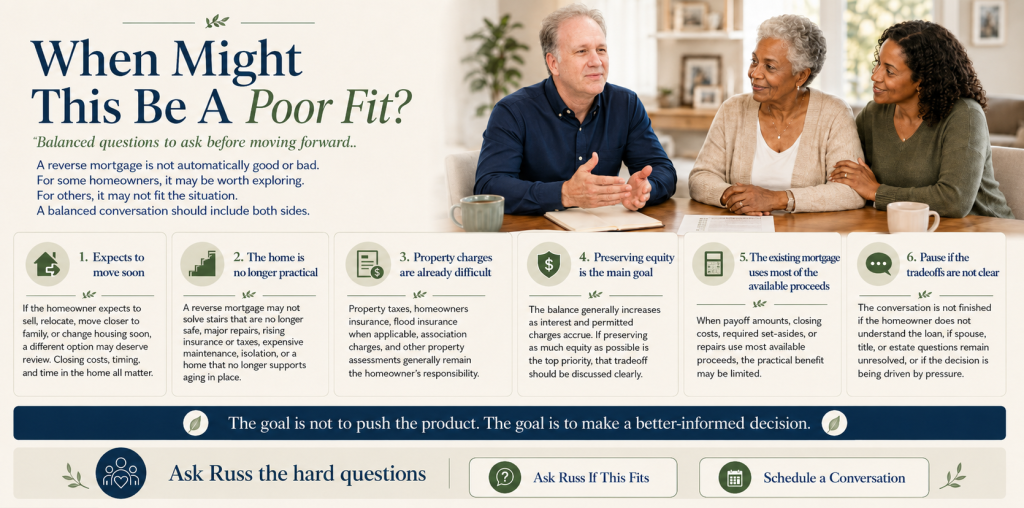
When Might This Be A Poor Fit?
Balanced questions to ask before moving forward.
A reverse mortgage is not automatically good or bad.
It is a loan secured by the home.
For some homeowners, it may be worth exploring.
For others, it may not fit the situation.
A balanced conversation should include both sides.
Not just:
“What could this help with?”
But also:
“What could make this a poor fit?”
The Homeowner Expects to Move Soon
A reverse mortgage may be less useful when the homeowner expects to move in the near future.
Closing costs, loan setup, repayment events, and time in the home all matter.
If the homeowner plans to sell, relocate, move closer to family, or enter another housing arrangement soon, a different option may deserve review.
The Home Is No Longer Practical
The home may be emotionally important but physically or financially difficult to maintain.
A reverse mortgage may not solve problems such as:
- Stairs that are no longer safe
- Major repairs
- High insurance costs
- Rising taxes
- Expensive maintenance
- Isolation from family or care
- A property that does not support aging in place
Sometimes the better question is not whether the homeowner can stay.
It is whether staying remains practical and safe.
Property Charges Are Already Difficult
Borrowers must continue paying required property charges.
That may include:
- Property taxes
- Homeowners insurance
- Flood insurance, when applicable
- Association charges
- Other property assessments
If those expenses are already difficult to manage, the homeowner should pause and review whether the property remains affordable.
A reverse mortgage does not remove those obligations.
Preserving Equity Is the Main Goal
A reverse mortgage balance generally increases as interest and permitted charges accrue.
That may reduce the equity remaining later.
If the homeowner’s top priority is preserving as much equity as possible for heirs, estate plans, or future sale proceeds, that priority should be discussed clearly.
A reverse mortgage may still be reviewed, but it should not be presented as having no effect on future equity.
The Existing Mortgage Uses Most of the Available Proceeds
If there is an existing mortgage or other required lien, it generally must be satisfied in connection with the reverse mortgage transaction.
When the current payoff is large compared with the home’s eligible value, little or no proceeds may remain after payoffs, closing costs, required set-asides, or repairs.
In that case, the homeowner should ask whether the practical benefit is enough to justify the transaction.
The Homeowner Does Not Understand the Tradeoffs
A homeowner should understand:
- The reverse mortgage is a loan
- The home secures the debt
- Scheduled monthly principal-and-interest payments generally are not required while the loan remains in good standing
- Interest and permitted charges generally accrue
- The balance generally increases
- Taxes and insurance remain the homeowner’s responsibility
- The home must remain the primary residence
- Maintenance remains required
- The loan eventually becomes due and payable
- Spouses and heirs may be affected
- Other options may exist
If those points are not clear, the conversation is not finished.
There Are Unresolved Spouse, Title, or Estate Questions
A reverse mortgage may affect more than one person.
Before moving forward, ask:
- Who is on title?
- Who will be a borrower?
- Is there a non-borrowing spouse?
- Does anyone else live in the home?
- Is the home in a trust?
- Do the heirs expect to keep the property?
- Are estate documents current?
- Should an attorney review the situation?
These questions should not be postponed until after closing.
The Decision Is Being Driven by Pressure
A reverse mortgage should not be rushed because someone is scared, embarrassed, or being pushed by another person.
Pause if someone says:
- You have to do this now
- Everyone qualifies
- This is free money
- The government is giving this to you
- You will never have another payment
- Your heirs do not need to worry
- Taxes and insurance will not matter
- You do not need to compare alternatives
A sound decision can survive questions.
The Bottom Line
A reverse mortgage may be worth exploring when it fits the homeowner’s goals, property, budget, family situation, and long-term plan.
It may be a poor fit when the home is no longer practical, property charges are not manageable, preserving equity is the priority, the homeowner expects to move soon, or the tradeoffs are not understood.
The goal is not to push the product.
The goal is to make a better-informed decision.
Ask Russ the Hard Questions
If you are wondering whether a reverse mortgage may not fit your situation, that is a good question to ask.
Russ can help review the tradeoffs, obligations, alternatives, and questions that should be answered before moving forward.
Primary button: Ask Russ If This Fits
Secondary button: Schedule a Conversation
Disclosure
A reverse mortgage is a loan secured by the home and is not appropriate for every homeowner. Scheduled monthly principal-and-interest payments generally are not required while the reverse mortgage remains in good standing. Borrowers must continue to occupy the home as their primary residence, maintain the property, and pay required property charges, including property taxes, homeowners insurance, applicable flood insurance, homeowners association charges, and other applicable property assessments.
Interest and other permitted charges generally accrue and are added to the loan balance over time, reducing remaining home equity. The loan generally becomes due and payable after a maturity event described in the loan documents, which may include the last borrower selling the home, permanently leaving the home as a primary residence, passing away, or failing to meet required loan obligations.
Eligibility, proceeds, costs, rates, payment options, set-aside requirements, spouse protections, heir options, and program availability depend on the specific product, borrower qualifications, property eligibility, financial assessment, underwriting, counseling where applicable, market conditions, state availability, and program requirements.
This information is for general educational purposes and does not recommend one home-equity option over another. It is not financial, tax, legal, insurance, real-estate, or estate-planning advice. It is not a loan approval, guarantee of eligibility, guarantee of proceeds, guarantee of monthly savings, or commitment to lend.
Russell Tunick
Mortgage Loan Originator | Reverse Mortgage Specialist
NMLS #305398
Powered by Go Rascal Inc.
Company NMLS #2072896
Equal Housing Lender
Cell: (917) 538-7177
Email: [email protected]
Website: russelltunick.com/