
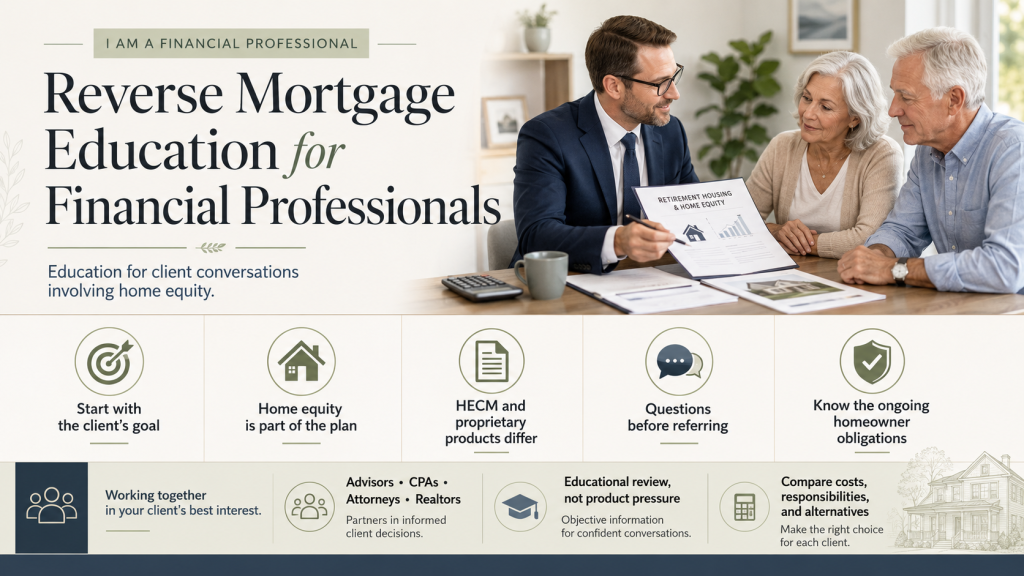
Education for client conversations involving home equity.
Home equity is often one of a client’s largest assets.
Yet in many retirement, estate, tax, and housing conversations, it is treated as separate from the rest of the plan—or left out entirely.
That can create a blind spot.
A client may have substantial equity while also managing a mortgage payment, limited monthly liquidity, home repairs, future care needs, or a strong desire to remain in the property.
That does not mean a reverse mortgage is automatically appropriate.
It means the home may deserve a place in the planning conversation.
Let’s slow this down and look at the mortgage side clearly.
Begin With the Client’s Goal
The first question should not be:
“Would this client qualify for a reverse mortgage?”
A better question is:
“What problem is the client trying to solve?”
The client may be trying to:
- Remain in the home longer
- Address an existing mortgage payment
- Improve monthly cash-flow flexibility
- Fund necessary home repairs or accessibility improvements
- Establish access to funds for future expenses
- Coordinate housing decisions with a retirement-income plan
- Purchase a home better suited to retirement
- Avoid selling other assets at an unfavorable time
- Prepare for a surviving spouse
- Manage the timing of a home sale
- Reduce pressure on family members
- Create a more workable long-term housing plan
Once the objective is defined, the professional team can compare available strategies without beginning with a product conclusion.
Home Equity Is Not the Same as Liquid Savings
A client may own a valuable home and still have limited access to cash.
Home equity generally represents the difference between the property’s value and the debt secured by it. Accessing that equity usually requires one of two things:
- Borrowing against the property
- Selling the property
Each option has costs, qualification requirements, risks, and planning consequences.
That distinction matters because clients sometimes assume that owning a valuable home means the equity is readily available whenever needed.
It may not be.
Traditional borrowing can depend on income, credit, debt obligations, property condition, lender requirements, and the client’s ability to make scheduled payments.
Selling can create relocation, tax, estate, timing, and lifestyle considerations.
A reverse mortgage is another possible structure, but it should be compared with the full range of alternatives.
A Plain-English Reverse Mortgage Overview
A reverse mortgage is a loan secured by the home.
For eligible borrowers, it may allow access to a portion of the home’s equity without requiring scheduled monthly principal-and-interest payments while the loan remains in good standing.
That sentence needs context.
The borrower generally must continue to:
- Occupy the property as a primary residence
- Pay property taxes
- Maintain required homeowners insurance
- Maintain applicable flood insurance
- Pay homeowners association or similar charges
- Maintain the property
- Comply with the loan terms
Interest and other permitted charges generally accrue and are added to the loan balance over time. As the balance grows, the remaining home equity may decline.
The loan generally becomes due and payable after a maturity event described in the loan documents, which may include the last borrower selling the home, permanently leaving the home as a primary residence, passing away, or failing to meet required obligations.
This is not free money.
It is a mortgage with a different repayment structure.
HECM and Proprietary Products Are Not Identical
The Home Equity Conversion Mortgage, commonly called a HECM, is a federally insured reverse mortgage program generally associated with homeowners age 62 or older.
Proprietary reverse mortgage products are privately offered and may have different:
- Age requirements
- Property-value limits
- Eligible property types
- Loan features
- Costs
- Proceed structures
- State availability
- Underwriting standards
- Spouse protections
- Repayment terms
Some proprietary programs may have lower age thresholds in certain states, but availability and requirements vary.
Professionals should not treat “reverse mortgage” as a single uniform product.
The exact program should be identified before making assumptions about eligibility, protections, costs, or estate consequences.
When a Reverse Mortgage Conversation May Be Appropriate
A mortgage education conversation may be worth considering when a client:
- Intends to remain in the home for a meaningful period
- Has significant home equity
- Wants to understand alternatives to a required monthly mortgage payment
- Can continue paying taxes, insurance, maintenance, and other property expenses
- Needs to evaluate the home as part of a broader retirement plan
- Is considering aging in place
- Is evaluating the timing of investment withdrawals or asset sales
- Wants to create access to funds without immediately selling the home
- Is considering purchasing a retirement residence
- Wants the professional team to understand the mortgage options before making a decision
These circumstances do not establish eligibility or suitability.
They simply suggest that education may be useful.
When It May Be a Poor Fit
A reverse mortgage may deserve extra caution when:
- The client expects to move soon
- The property is no longer physically suitable
- Taxes, insurance, association charges, or maintenance may be unaffordable
- Preserving the maximum possible home equity is a dominant goal
- The existing mortgage balance is too large relative to available proceeds
- The client does not understand the growing loan balance
- A spouse or resident’s future housing rights are unclear
- The client is being pressured by family, a salesperson, or another party
- The home requires repairs the client cannot reasonably manage
- The family expects to retain the property but has no realistic repayment plan
- The proposed transaction conflicts with estate, benefits, tax, or legal planning
- A less costly or simpler alternative may meet the same objective
A professional referral should not begin with the assumption that the transaction will close.
Sometimes the most useful result of the review is learning that another option fits better.
Variables That Affect the Mortgage Review
A reverse mortgage analysis may depend on:
- The client’s age and the applicable program requirements
- The age and status of a spouse
- The eligible property value
- Property type and condition
- The existing mortgage payoff
- Other liens or title issues
- Interest-rate assumptions
- The selected program
- Financial assessment
- Property charges
- Required repairs
- Required set-asides, when applicable
- The proposed method of receiving proceeds
- State and investor availability
- Counseling requirements
- Underwriting and verification
A calculator may provide an educational estimate, but it cannot establish final eligibility, proceeds, costs, or approval.
Borrower-specific figures require a full review.
Existing Mortgage Balances Matter
Many clients who explore a reverse mortgage still have a traditional mortgage, home-equity loan, or line of credit.
Those balances generally must be addressed as part of the transaction when required for the new reverse mortgage to obtain the proper lien position.
Available reverse mortgage proceeds may first be used to satisfy:
- The existing mortgage
- Other required liens
- Closing costs
- Required set-asides or repairs, when applicable
The remaining amount, if any, depends on the transaction.
A client should not assume that the gross reverse mortgage amount and the amount available after closing are the same.
For planning purposes, request a clear explanation of:
- Estimated gross proceeds
- Mortgage and lien payoffs
- Closing costs
- Required set-asides
- Repair obligations
- Estimated net availability
- How the balance may change over time
Cash Flow Should Not Be the Only Measure
A reverse mortgage may change a client’s required monthly mortgage-payment structure.
That can be relevant to cash-flow planning.
But focusing only on the monthly budget can obscure other consequences.
A complete review should also consider:
- Upfront costs
- Ongoing interest accrual
- Mortgage-insurance charges when applicable
- The increasing loan balance
- Remaining equity
- Expected tenure in the home
- Property expenses
- Estate goals
- Spouse and resident considerations
- Liquidity needs
- Alternative sources of funds
- The client’s ability to maintain the property
- What happens after a maturity event
The objective is not simply to create a lower required payment today.
It is to understand how the strategy fits the client’s entire housing and financial picture.
A Framework for Client Conversations
Professionals can begin with five areas.
1. The Client’s Objective
Ask:
- What is the client trying to accomplish?
- Why is the issue arising now?
- Is the need temporary, recurring, or long-term?
- Is remaining in the home still realistic?
- What happens if nothing changes?
2. The Property
Review:
- Estimated value
- Existing mortgages and liens
- Property condition
- Expected repairs
- Accessibility
- Taxes and insurance
- Association charges
- Suitability for long-term residence
3. The Household
Consider:
- Who owns the home?
- Who lives there?
- Who would be a borrower?
- Is there a spouse who may not be a borrower?
- Is anyone relying on the home for future housing?
- Who will manage property obligations?
- Are there capacity, power-of-attorney, trust, or guardianship questions?
4. The Financial Plan
Ask:
- How does the current housing cost affect the budget?
- What other liquid resources are available?
- What assets would otherwise be sold?
- What emergency reserves should remain intact?
- How would this affect future flexibility?
- What risks arise if the client stays in the home?
- What risks arise if the client sells?
5. The Estate and Family Plan
Discuss:
- Does the client want to preserve the home for heirs?
- Do the heirs actually want the property?
- Could they realistically repay or refinance the balance?
- Is the expected inheritance the home, the remaining equity, or something else?
- Has the client communicated the plan?
- Are legal documents consistent with the intended strategy?
Questions Financial Professionals Should Ask the Mortgage Specialist
Before relying on a reverse mortgage illustration or proposal, ask:
- What exact product is being presented?
- Is it a HECM or proprietary reverse mortgage?
- What age and property requirements apply?
- Is the program available in the client’s state?
- How is the available amount determined?
- What existing debts must be satisfied?
- What are the estimated upfront costs?
- Which charges may accrue over time?
- Is the rate fixed or adjustable?
- How may the client receive proceeds?
- Are any funds restricted or set aside?
- What financial-assessment requirements apply?
- Is counseling required?
- What repairs or property conditions must be addressed?
- What obligations continue after closing?
- What events cause the loan to become due?
- What protections apply to the spouse?
- What happens to a non-borrowing resident?
- What options may be available to heirs?
- What assumptions are being used in the illustration?
- Which figures are estimates rather than final terms?
A clear mortgage explanation should make the planning conversation easier—not more confusing.
Questions to Ask Before Referring a Client
A useful referral may begin with:
- Is the client seeking education or already asking for an application?
- Does the client understand that this is a loan?
- Is the client comfortable discussing the home and household obligations?
- Has the client identified a goal?
- Should a spouse or family member participate?
- Are there estate, trust, title, benefits, or tax issues that need separate advice?
- Does the client expect to move?
- Is the client able to maintain the home and pay property charges?
- Is the client being pressured?
- Is the client comparing alternatives?
The referral should be positioned as an educational review, not an endorsement of a transaction.
Working With a Financial Advisor
A financial advisor may be evaluating:
- Portfolio-withdrawal timing
- Liquidity
- Sequence-of-returns exposure
- Concentration in housing wealth
- Emergency reserves
- Legacy objectives
- Long-term-care planning
- Housing affordability
- The effect of debt on the retirement plan
The mortgage professional should explain the available loan structure, estimated costs, obligations, and repayment events.
The financial advisor should evaluate how those facts fit the client’s investment, income, risk, and planning strategy.
Neither role should be blurred.
Working With a CPA or Tax Professional
Reverse mortgage proceeds are loan advances rather than earned income, but individual tax consequences can depend on how funds are used, how interest is treated, and the client’s broader circumstances.
The mortgage professional should not give tax advice.
A CPA or tax professional may need to consider:
- Interest deductibility rules
- Timing of interest payment
- Basis and sale considerations
- Use of proceeds
- Business or rental complications
- Trust ownership
- Estate administration
- Interaction with other taxable events
No general website article can determine an individual client’s tax result.
Working With an Attorney or Estate Planner
Legal review may be especially important when the property involves:
- A trust
- A life estate
- Multiple owners
- A non-borrowing spouse
- Powers of attorney
- Guardianship or conservatorship
- Capacity concerns
- Divorce or separation
- Probate planning
- Multiple heirs
- A family member living in the property
- Medicaid or public-benefit planning
- A desire to preserve the home for a particular beneficiary
The mortgage professional can explain loan requirements and title-related conditions communicated by the lender.
The attorney should address legal rights, authority, ownership, estate documents, and planning consequences.
Working With a Realtor
A Realtor may become involved when the client is comparing:
- Remaining in the current home
- Selling and downsizing
- Moving closer to family
- Purchasing a more suitable home
- Using a reverse mortgage purchase option
- Preparing the current home for sale
- Estimating future housing costs
The Realtor’s market and property knowledge can help clarify whether staying is practical.
The mortgage professional can explain financing structures.
Neither professional should assume that staying or selling is automatically the better answer.
Working With Adult Children and Heirs
Family concerns often center on:
- Whether the lender will own the home
- Whether the parent can remain there
- What happens after death or a permanent move
- Whether the children can keep the property
- Whether an inheritance will remain
- How the balance will be repaid
- What a spouse or resident should expect
The professional team should avoid promising that:
- The heirs will have no risk
- The home will definitely remain in the family
- A certain amount of equity will remain
- A spouse or resident will always be protected
- The loan can never become due during the borrower’s lifetime
The actual outcome depends on the product, loan balance, property value, title, borrower obligations, loan documents, and individual circumstances.
What Heirs Generally Need to Understand
When a reverse mortgage becomes due and payable, the estate or heirs generally need to communicate with the servicer.
Depending on the loan and circumstances, they may consider:
- Selling the home
- Repaying the required balance
- Refinancing to retain the property
- Pursuing another option permitted by the loan or program
Requirements and timelines matter.
Families should know where the loan documents are kept, who the servicer is, and who will be responsible for communicating with the servicer.
These steps are easier when the family has discussed the plan in advance.
Professional Boundaries Matter
A reverse mortgage specialist should explain:
- Mortgage products
- Eligibility factors
- Estimated loan amounts
- Loan costs
- Proceed options
- Property requirements
- Borrower obligations
- Counseling requirements
- The loan process
- Repayment events
The reverse mortgage specialist should not replace:
- Financial planning
- Investment advice
- Tax advice
- Legal advice
- Estate planning
- Benefits planning
- Insurance advice
- Real-estate valuation advice
The strongest client experience usually comes from professionals staying within their roles while sharing enough information to support an informed decision.
Referral and Collaboration Guardrails
A professional introduction should be based on the client’s need for education.
It should not depend on:
- A promised closing
- A referral fee
- Reciprocal business
- A required use of another provider
- Undisclosed compensation
- Pressure on the client
- An unapproved marketing arrangement
Any co-marketing, referral-compensation, event-sponsorship, lead-sharing, or service arrangement should be reviewed and approved by the appropriate compliance and legal teams before implementation.
The client should remain free to choose their own professionals and service providers.
Warning Signs for Professionals
Pause the conversation if the client has been told:
- “Everyone qualifies”
- “This is free money”
- “The government pays you”
- “You will never have another housing expense”
- “You cannot lose the home”
- “Taxes and insurance no longer matter”
- “The heirs do not need to know”
- “There is no effect on inheritance”
- “The proceeds are guaranteed”
- “You must act immediately”
- “Counseling is just a formality”
- “There are no meaningful costs”
- “This product is always better than selling or refinancing”
Also pause when:
- The client cannot explain the basic obligations
- A spouse or resident’s status is unclear
- The client appears confused or pressured
- Material costs are missing
- The illustration and verbal explanation do not match
- The client’s stated goal is not being addressed
- No alternatives have been discussed
- Capacity, coercion, or financial-abuse concerns exist
A sound recommendation should withstand careful questioning.
Documentation Worth Reviewing
Depending on the client and professional role, useful documents may include:
- Current mortgage statements
- Payoff information
- Home-equity loan or line statements
- Property-tax records
- Homeowners and flood-insurance records
- Association statements
- Deed and title information
- Trust documents
- Powers of attorney
- Estate-planning documents
- Household budget
- Property-repair estimates
- Reverse mortgage illustrations
- Loan estimates and closing disclosures when issued
- Counseling certificate where applicable
Sensitive client information should only be transmitted through approved secure systems.
How Russ Works With Financial Professionals
My role is to explain the mortgage side of the conversation.
That may include:
- Reviewing the client’s housing objective
- Explaining reverse mortgage structures
- Discussing existing mortgage balances
- Identifying continuing homeowner obligations
- Reviewing estimated costs and proceeds
- Explaining how the loan balance may change
- Discussing maturity and repayment events
- Helping the client prepare questions
- Clarifying when another professional should be involved
- Comparing mortgage alternatives at a general educational level
I do not replace the client’s financial advisor, CPA, attorney, Realtor, insurance professional, or benefits specialist.
The goal is to give the client and professional team accurate mortgage information so each person can evaluate the decision within their own area of responsibility.
A Better Professional Referral
A helpful introduction might sound like this:
“I would like you to speak with a reverse mortgage specialist for education. This is not a recommendation that you complete a loan. The purpose is to understand how the option works, what it costs, what responsibilities remain, and whether it deserves further consideration alongside your other alternatives.”
That language protects the quality of the conversation.
The client is not being handed a conclusion.
The client is being given a resource.
Frequently Asked Questions
Is a reverse mortgage appropriate for every homeowner over 62?
No. Age is only one factor, and not every client will qualify or find the product suitable. The property, existing debt, financial assessment, ongoing obligations, expected time in the home, costs, spouse considerations, and client goals all matter.
Can professionals rely on an online calculator?
A calculator may provide an educational estimate. It is not an approval, commitment to lend, or final determination of proceeds, costs, or terms.
Does a reverse mortgage eliminate all housing expenses?
No. The borrower remains responsible for property taxes, insurance, maintenance, applicable association charges, utilities, and other homeownership costs.
Can the client make voluntary payments?
Many reverse mortgage structures permit voluntary repayment without requiring scheduled monthly principal-and-interest payments. The exact loan terms should be reviewed before advising the client.
Will heirs inherit the debt?
The rights and obligations of the estate and heirs depend on the product and loan documents. Reverse mortgages are commonly structured as non-recourse loans, but professionals should verify the exact product terms rather than relying on a general assumption.
Can heirs keep the property?
They may have options to repay or refinance the required balance and retain the home. Whether that is practical depends on the balance, property value, financing, estate plan, and applicable deadlines.
Does a reverse mortgage affect government benefits?
It may, depending on the benefit program, how proceeds are received, and whether funds remain in an account. A qualified benefits or legal professional should evaluate the client’s specific circumstances.
Is reverse mortgage counseling required?
Independent counseling is generally required for HECM transactions. Counseling requirements for proprietary products may differ by program and jurisdiction.
Should the financial professional attend the mortgage meeting?
The client may benefit from coordinated communication, with appropriate authorization and consent. Each professional should remain within their role and protect client confidentiality.
Is referring a client the same as recommending the loan?
No. A referral can be framed as an educational introduction. The client should still evaluate the product, alternatives, costs, and professional advice before making a decision.
Add the Mortgage Facts to the Client Conversation
You do not need to determine whether a reverse mortgage is appropriate before reaching out.
Bring the client’s questions, planning objective, and relevant housing information.
I can explain the mortgage structures, responsibilities, costs, and tradeoffs so you and the client can decide whether the conversation should continue.
Primary button: Request an Educational Conversation
Secondary button: Ask Russ a Question
Disclosure
Important reverse mortgage information: A reverse mortgage is a loan secured by the home. Interest and other permitted charges generally accrue and are added to the loan balance over time, reducing the remaining home equity.
Borrowers must continue to occupy the property as their primary residence, maintain the home, and pay required property charges, including property taxes, homeowners insurance, applicable flood insurance, and homeowners association charges. Failure to meet these obligations may cause the loan to become due and payable.
The loan generally becomes due and payable after a maturity event described in the loan documents, which may include the last borrower selling the home, permanently leaving the home as a primary residence, passing away, or failing to meet required loan obligations.
Eligibility, available proceeds, costs, rates, spouse protections, repayment terms, and program availability depend on the specific product, borrower qualifications, property eligibility, financial assessment, underwriting, counseling where applicable, state availability, and program requirements.
This material is intended for general professional education. It is not a loan approval or commitment to lend and is not financial-planning, investment, tax, legal, benefits, insurance, real-estate, or estate-planning advice. Professionals and clients should consult appropriately qualified advisors regarding their individual circumstances.
Russell Tunick
Mortgage Loan Originator | Reverse Mortgage Specialist
NMLS #305398
Powered by Go Rascal Inc. | NMLS #2072896
Equal Housing Lender
Cell: (917) 538-7177
Email: [email protected]